
Medically reviewed by Nachiket J. Patel, MD, FACC, FSCAI. Last medically reviewed: August 2026.
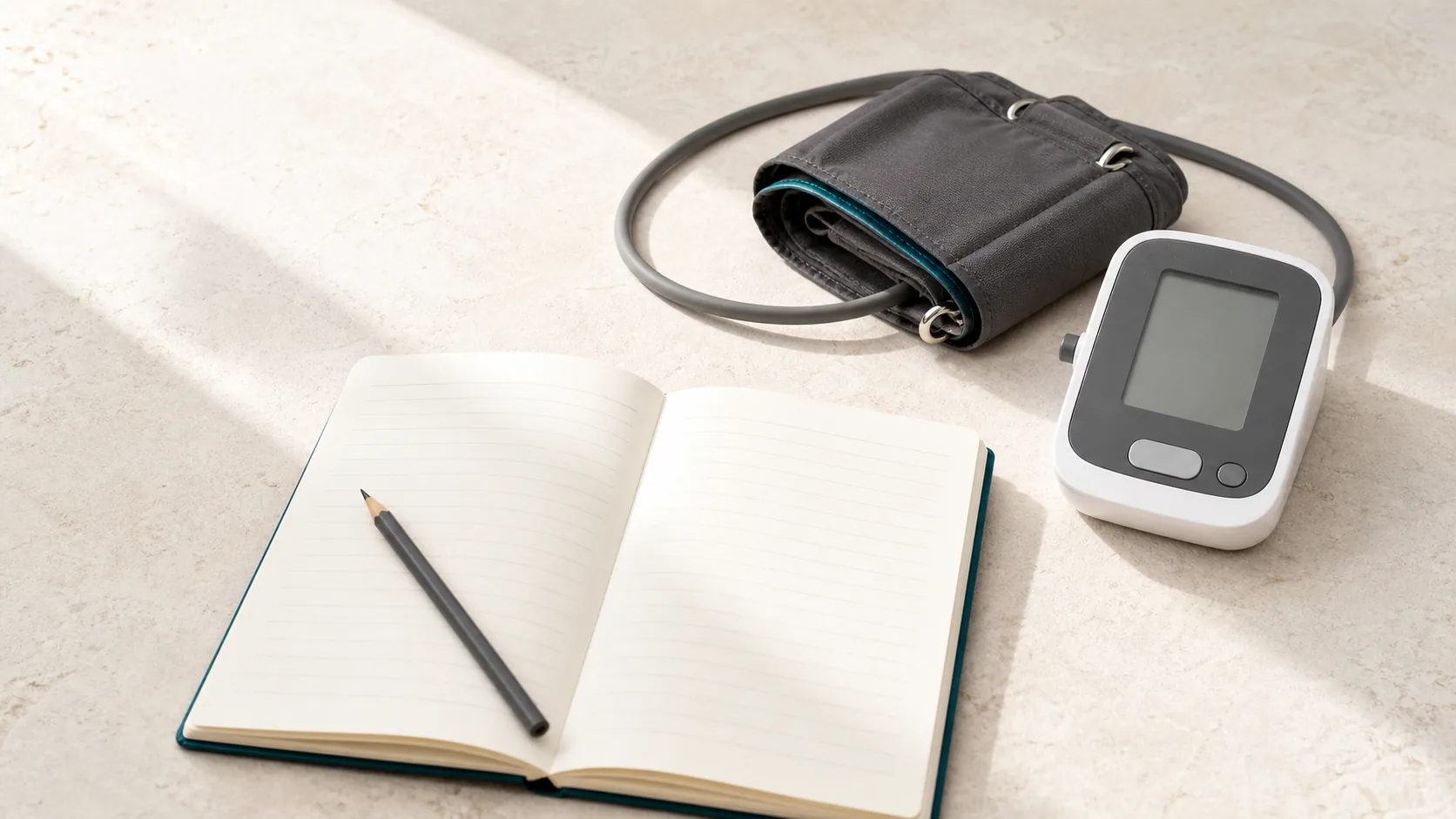
A home blood-pressure monitor can answer questions that one office reading cannot. It can show whether pressure is consistently elevated, whether medication is working throughout the day, and whether an office reading reflects a broader pattern or a stressful moment.
The device is only part of the measurement, however. An incorrect cuff, unsupported arm, full bladder, recent caffeine, or conversation during the reading can change the result. The goal is not to produce the lowest possible number. It is to collect measurements that reflect ordinary blood pressure under consistent conditions.
Start with the right monitor and cuff
Use a validated, automatic monitor that measures at the upper arm. Wrist and finger devices are generally less reliable, and the 2025 multisociety blood-pressure guideline advises against relying on cuffless devices, including smartwatches, until their accuracy improves.
Cuff size matters. A cuff that is too small can produce a falsely high reading; one that is too large can also distort the result. Follow the monitor manufacturer’s sizing guide.
Bring the monitor and cuff to an appointment. The clinical team can check the fit, watch your technique, and compare the device with office equipment. The American Heart Association also recommends having the device checked periodically, including about once a year or as directed by its manufacturer.
Prepare before each measurement
For at least 30 minutes before checking your pressure, avoid smoking or nicotine, caffeine, and exercise. Empty your bladder. Do not place the cuff over clothing.
Sit quietly for at least five minutes before starting. Talking, using the phone, or answering questions during that interval can defeat the purpose.
If a clinician has asked for morning and evening readings, use approximately the same times each day. Ask whether the morning measurement should occur before or after medication; the answer depends on what the clinician is trying to learn. Do not delay or change a prescribed dose unless you have been given specific instructions.
Use a position you can reproduce
Sit in a chair with your back supported. Keep both feet flat on the floor and your legs uncrossed. Rest the arm on a table or other firm surface so the middle of the cuff is level with your heart.
Wrap the cuff around bare skin just above the bend of the elbow, following the device instructions. Remain still and silent while the monitor runs.
Readings taken without back and arm support may not be comparable with standardized office measurements.
Take more than one reading
Take two readings one minute apart and record both unless your clinician gives different instructions. Blood pressure naturally changes from moment to moment, so a small difference is expected.
Record the date, time, systolic pressure, diastolic pressure, and pulse. Add a brief note only when it provides useful context—for example, a missed dose, significant pain, unusual symptoms, or a measurement taken soon after returning from work.
Do not repeatedly measure until the number becomes reassuring. A defined schedule and an average across several days are more useful than a cluster from one worried hour.
Look for patterns, not a single “good” or “bad” number
One elevated result does not establish a diagnosis, and one normal result does not erase a persistent pattern. Home measurements can help identify:
- Sustained hypertension: readings are elevated in and outside the office.
- A white-coat pattern: office readings are higher than properly obtained home readings.
- Masked hypertension: office readings appear acceptable, but readings during ordinary life are elevated.
- Treatment-related lows: pressure falls too far at certain times or with standing, sometimes with dizziness or weakness.
These patterns should be interpreted with your medical history, medications, kidney function, and overall cardiovascular risk. Do not stop medication because several readings look normal; normal pressure may mean the treatment is working.
Common problems that make a log less useful
A home record becomes harder to interpret when readings are taken with different arms, positions, cuffs, or times without explanation. Other common problems include measuring immediately after climbing stairs, talking during the reading, rounding the numbers, or recording only the highest or lowest result.
An irregular heartbeat can also challenge some automated monitors. If the device repeatedly displays an irregular-rhythm symbol, save the readings and discuss them with a clinician. The symbol is a screening signal, not a diagnosis of atrial fibrillation or another arrhythmia.
When a reading needs prompt action
If your pressure is higher than 180/120 mm Hg, wait at least one minute and measure again using proper technique.
If the repeat reading remains higher than 180/120 and you have chest pain, shortness of breath, back pain, numbness, weakness, a change in vision, difficulty speaking, or another new and concerning symptom, call 911. Do not wait to see whether the pressure falls on its own.
If the repeat reading remains that high without those symptoms, contact a health care professional as soon as possible. Do not take extra prescription medication unless a clinician has already given you a specific plan.
Call 911 for possible heart-attack or stroke symptoms even if the blood-pressure number is lower. Pregnancy-related blood-pressure concerns require separate, prompt guidance from an obstetric clinician.
Bring the record into the decision
A useful log should make the next conversation clearer. Bring the monitor, cuff, readings, and an accurate medication list to the appointment. The important questions are not only “How high did it get?” but also “Is this the usual pattern?” and “Would changing treatment reduce risk without creating dizziness, falls, kidney problems, or other side effects?”
At Flow Heart & Vascular, home measurements are considered alongside office technique, symptoms, previous records, and cardiovascular risk. The purpose of monitoring is to improve a decision—not to turn every normal fluctuation into an alarm.
Sources and Further Reading
- American Heart Association. Home Blood Pressure Monitoring. Reviewed August 14, 2025.
- American Heart Association/American College of Cardiology. Top Things to Know: 2025 High Blood Pressure Guideline. Updated August 14, 2025.
- American Heart Association. When To Call 911 About High Blood Pressure. Reviewed August 14, 2025.
Related heart and vascular information
Schedule an appointment
If you would like a focused review of your symptoms, risk, testing, or treatment options, request an appointment with Flow Heart & Vascular in Mesa, Arizona.
This article provides general education and does not replace individualized medical advice, diagnosis, or emergency care. Do not start, stop, or change medication or delay emergency care based only on information on this website.
